Showing posts with label animals. Show all posts

Friday, March 6, 2020

Writing Rhyming Riddles like Guess Again!

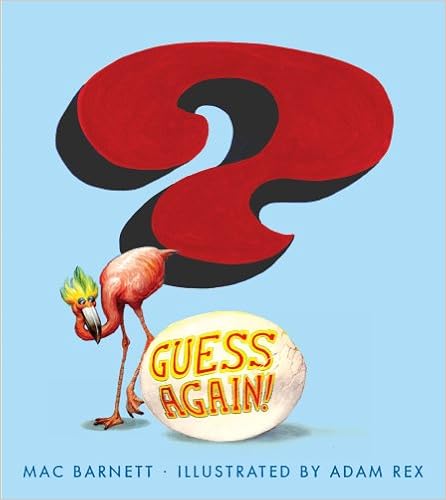
Today I had a class visit from a T/K class from McKinley Elementary School. I knew it would have to be a very quick visit, because it would just be a part of their city center field trip. Fortunately, I had one of my favorite picture books on hand, Guess Again! by Mac Barnett and illustrated by Adam Rex.


Each spread of the book shows a picture that appears to be an animal, and despite a lot of hints in the rhyming riddle, it turns out to be a person--usually in a very odd and funny-looking position! I love Mac Barnett's writing style. Combined with Adam Rex's masterful illustrations, the book engages kids in thinking about rhymes and piecing clues together to solve a riddle.

The kids were great about guessing each animal that they were being led to guess, following the picture cues and the rhyme cues. (I'm thinking they would do a great job with the Listener Limerick Challenge on Wait Wait Don't Tell Me!) And by the end, just when the kids are starting to get wise to the joke, the joke is once again turned around on them! To be honest, this might be a book you share with a kid who is particularly patient. There's something almost snarky about the way this book NEVER rewards you for guessing the obvious! 

After reading the book, I pulled out my big writing pad, on which I had a few prompts and blank lines written out.


I asked the kids to name an animal. The first child I called on said "Elephant" -- unfortunately, I don't know any good rhymes with "elephant" (though if you can think of any, please leave some in the comments!!!). So I had to call on someone else, and she said "Giraffe."  "Okay!" I said. "I can work with that one!"

We wrote out a few words that rhyme with giraffe (at least, the last syllable). Then we decided it would be a boy, and I asked the kids to start telling me what they know about giraffes. The first kid I called on for this section gave me a sentence about laughing, so I decided to make "Laugh" our special rhyming word. I put the word "laugh" in the box, and then wrote a draft sentence with the word "laugh" at the end.

Once we had a few other sentences about giraffes, we were ready to fill out our riddle. We decided that the end of the riddle would of course not be "Giraffe" -- like in Guess Again, we ended with a different person. Kids wanted a monkey, so we landed on Mr. Monkey, a favorite children's book character of mine.

Then I decided to cut a few extraneous words--editing is part of writing!


If you'd like to try out this activity, and use easy-to-print handouts to lead a group of kids to create a whole book full of these silly riddles, check out my book, 36 Workshops to Get Kids Writing. And if you haven't already got Guess Again! by Mac Barnett and Adam Rex, buy it! It's a great one to have on hand for storytimes with kindergartners and up. 

Tuesday, November 26, 2019

There Was an Old Lady...

Every year, I teach this song to my Infant Storytime patrons. Sometimes, I feel a little bit self-conscious because of the lyrics. It's not ha-ha funny to speak of someone dying, certainly. But regardless, I come back to it again and again.


There was an old lady who swallowed a fly.
I don't know why she swallowed a fly - I think she'll die!
There was an old lady who swallowed a spider;
That wriggled and jiggled and tickled inside her!

She swallowed the spider to catch the fly;
I don't know why she swallowed a fly - Perhaps she'll die!
There was an old lady who swallowed a bird;
How absurd to swallow a bird!

She swallowed the bird to catch the spider;
That wriggled and jiggled and tickled inside her!
She swallowed the spider to catch the fly;
I don't know why she swallowed a fly - I think she'll die!
There was an old lady who swallowed a cat;
Imagine that! She swallowed a cat!

She swallowed the cat to catch the bird,
She swallowed the bird to catch the spider;
That wriggled and jiggled and tickled inside her!
She swallowed the spider to catch the fly;
I don't know why she swallowed a fly - I think she'll die!
There was an old lady that swallowed a dog;
What a hog, to swallow a dog!

She swallowed the dog to catch the cat,
She swallowed the cat to catch the bird,
She swallowed the bird to catch the spider;
That wriggled and jiggled and tickled inside her!
She swallowed the spider to catch the fly;
I don't know why she swallowed a fly - I think she'll die!
There was an old lady who swallowed a goat;
She just opened her throat and swallowed a goat!

She swallowed the goat to catch the dog,
She swallowed the dog to catch the cat,
She swallowed the cat to catch the bird,
She swallowed the bird to catch the spider;
That wriggled and jiggled and tickled inside her!
She swallowed the spider to catch the fly;
I don't know why she swallowed a fly - I think she'll die!
There was an old lady who swallowed a cow;
I don't know how she swallowed a cow!

She swallowed the cow to catch the goat,
She swallowed the goat to catch the dog,
She swallowed the dog to catch the cat,
She swallowed the cat to catch the bird,
She swallowed the bird to catch the spider;
That wriggled and jiggled and tickled inside her!
She swallowed the spider to catch the fly;
I don't know why she swallowed a fly - I think she'll die!
There was an old lady who swallowed a horse;

...She died, of course!


I always worry that someone will complain that this nonsense song is too scary or too dark for children, or that they won't like all the talk of dying. There was a grandmother in my Toddler Storytime many years ago, who said she thought the idea of a person swallowing a dog gave her granddaughter nightmares. I felt so horrible about that, I didn't do the song for a while. But I've started to do it again in my Infant Storytimes, in hopes that the kids in those storytimes probably aren't going to think very hard about the words, but get the benefit of the language. I'm writing this blog post in an effort to justify that choice.

The song is a treasure trove of literacy building exercises. It's got plenty of rhymes (some very witty ones, too!), repetition, and it is what we in the library/education world call a "cumulative song," meaning that each verse adds a line to what we already have. Each verse thus gets longer. It's also got something babies love: tickles! I always do tickles at the spider part. I always teach parents to build up anticipation for the tickles too, by showing their children the wriggly, jiggly spider with their wiggling fingers, waiting for just the right moment to tickle them. Anticipation is an amazing memory building activity for children. First they see the "spider" and remember that tickles are coming--then eventually they hear "She swallowed the bird to catch the spider" and they get excited knowing that the spider is coming next. For all of these reasons, I think it's a valuable brain-building tool for babies and I continue to use it in storytime.

But if I'm being honest, there's also a more personal, sentimental reason this song means a lot to me. And it all comes back to an old lady.

Her name was Anna Skiendzielewska. She was born in Popowa, Poland in 1892. She was my grandmother's mother. She and her husband both immigrated to the United States, though I haven't yet found her immigration records. Her husband died, leaving Anna to raise four children on her own while struggling to learn English and assimilate to a new culture. And just to make her life even more fun, the Great Depression hit! Anna suffered a mental collapse of some kind, and her oldest daughter, my grandmother Mary, had to raise her three younger siblings.

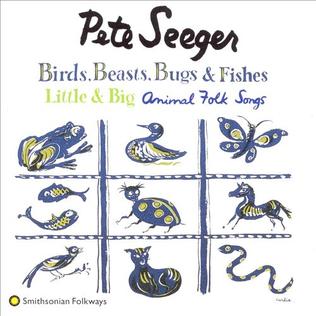
Anna recovered from her mental illness and eventually she must have learned some English, because my father remembers her singing a song to him when he was small: "There was an old lady who swallowed a fly..." This may have been after Pete Seeger recorded the song in an album Birds, Beasts, Bugs and Little Fishes (1955), or even earlier when Burl Ives released it in 1953 on Folk Songs, Dramatic and Humorous. Anna probably owned one of those albums. Listening to it may have even helped her with her English.


Anna did eventually die, of course, on December 6, 1966, at the age of 74. She'd had a hard life, left behind an impoverished country for a cold, alien one, only to be hit with all kinds of new struggles. But she lived a long time anyway, enough to leave her grandson, my father, with good memories.

When I was little my dad sang that song to me, and when I had my first child in 2010, I sang it to her. The song always used to cheer my daughter up any time she was upset or crying. I'd always ham it up. I remember one incident, on a trip in San Francisco in summer 2010, when she was tired from a long day of roaming the gardens at Golden Gate Park. She started crying, her little face scowling, and I just started singing: "There was an old lady who swallowed a fly..."

The change in her features was magical: her scrunched-up, frustrated little baby face suddenly transformed into a toothless smile. She was anticipating the sound of the words, the surprise and excitement of the tickles.

If you don't believe me, I still have the footage of that very moment!


And, although Anna Skiendzielewska had been dead for forty-four years, I like to think of her smiling at that moment, to see how easily the old nonsense song shifted her great-great-granddaughter's mood.

That's why I still sing the song. For me, it represents the power of folk songs to bridge cultures and generations, teach language, and build brains! And, though some of the lyrics might be a bit difficult to "swallow" (ahem), I think their power for literacy is something to smile about.

My daughter trying--and failing--to swallow a butterfly

Sunday, December 9, 2018

Kids Can Make Board Books--Here's How!


Last month, we had a Writing Party for kids 5-8 years old about making a board book for a baby relative or friend. Turnout was huge! It was one of the most exciting writing programs I've ever done at the library. Kids and their families came and had a blast putting together books with flaps that lift and textures for a baby to touch.

In developing this program I had to first create a sample. The theme or premise of my board book (which I later gave to my baby nephew) was looking for a bunny and lifting flaps throughout, to find other animals there, then finding Bunny at the very end. Looking for something is a common premise in lift-the-flap books, and it introduces elements of surprise, as well as different vocabulary words, and builds up just enough suspense for an infant to take an interest in what's going on.


I showed the kids my finished, colored board book and then gave them some other examples of board books from our library's collection to help them get ideas for their own books.

Supplies:


  • Blank board books
  • Cardstock of different colors and heavy thickness
  • Lots of sharpies of different colors! Regular markers will smear on these board books.
  • Full-sheet labels (for printing out animal stickers, useful if kids want an illustration aid)
  • Scissors
  • Liquid glue bottles
  • Lots of different fabrics: fleece, felt, wool, fur, faux leather, suede (I pre-cut the fabrics into squares about the right size, so that kids could just come to the table and grab them and trim them to the desired shape)
  • Feathers


I printed color "flaps" on white cardstock and animal images on full sheet sticker labels, and put the sheets out for kids to take and cut out. You can download everything here:

Flaps to cut out

Stickers

Stickers 2

Kids had a lot of fun crafting their books, and parents were wonderfully helpful and engaged!


And then comes my favorite part... When the kids show off their books and read me what they wrote or tell me what they planned to write! Check out these budding authors. Those baby recipients are super lucky to be getting these books for Christmas!

[youtube https://www.youtube.com/watch?v=2BvvH6gpAB8&w=560&h=315] [youtube https://www.youtube.com/watch?v=IrJVFzDuNVo&w=560&h=315] [youtube https://www.youtube.com/watch?v=5Oedou45BDE&w=560&h=315] [youtube https://www.youtube.com/watch?v=r6rMll7TLCE&w=560&h=315] [youtube https://www.youtube.com/watch?v=8E3Um0vh-xs&w=560&h=315] [youtube https://www.youtube.com/watch?v=mjmfhZIzigE&w=560&h=315] [youtube https://www.youtube.com/watch?v=vJkx9ezyK3c&w=560&h=315] [youtube https://www.youtube.com/watch?v=RTNB9Ea8eGg&w=560&h=315]

I hope these videos and pictures demonstrate that writing workshops CAN indeed be fun for kindergartners, first and second graders, and they can draw big crowds and encourage developing literacy skills, especially when there is a craft or artistic element to the workshop! Can't wait to do another writing party, perhaps in the spring!

Sunday, March 4, 2018

How to Make 3D Seussian animals

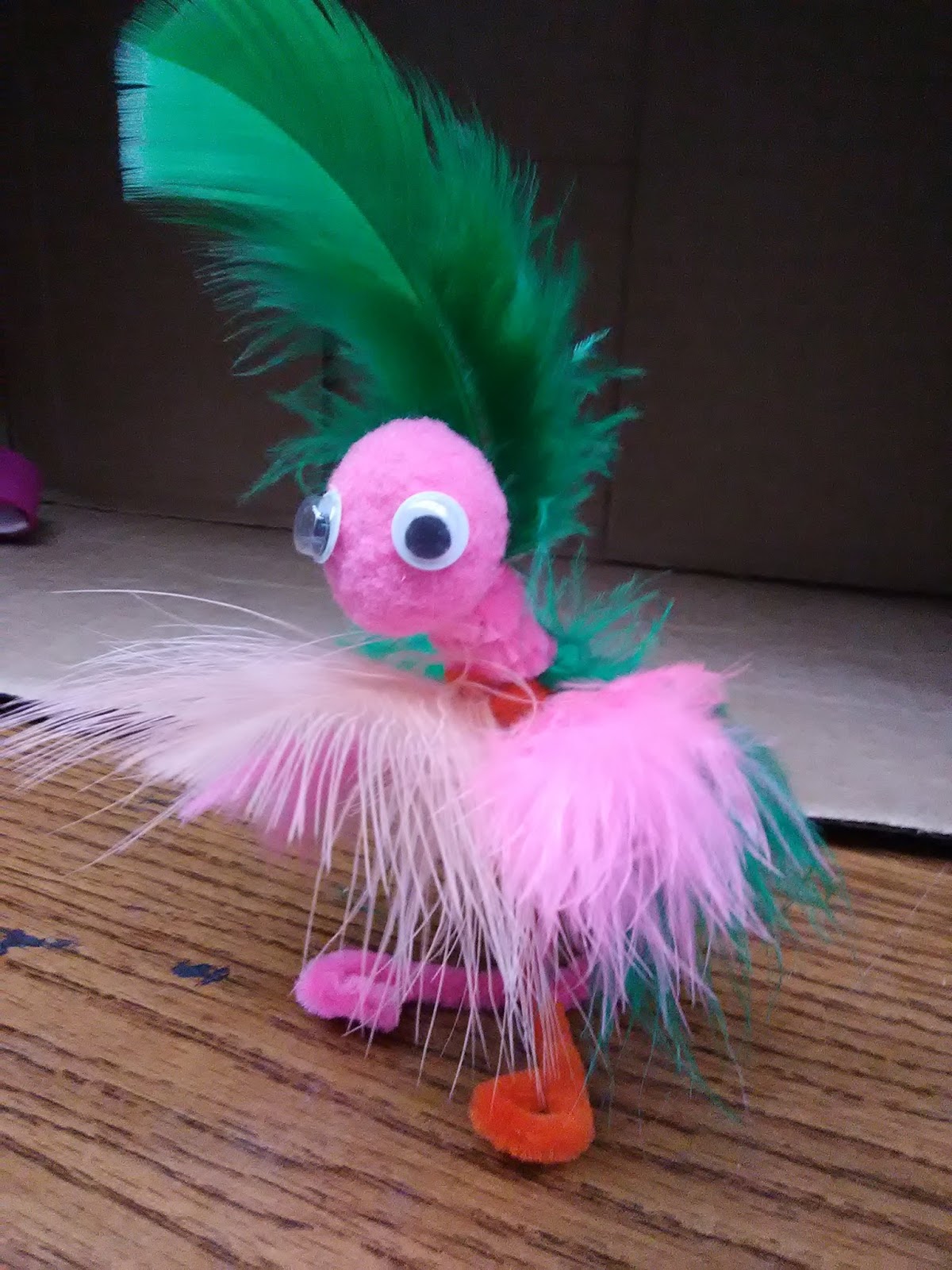
One of the workshops in my book involves creating a Dr. Seuss-inspired animal with a name that is a combination of different names from Dr. Seuss books. The handout gives kids a prompt to draw their animal, but if you want to get more crafty, you could also try making them in 3D!

You will need:
Pipe cleaners
Feathers
Pom poms
Googly eyes

Show the kids how to wrap a pipe cleaner around a pen or pencil to create a "body" that has more substance (and spring!) to it than a straight pipe cleaner would. It also allows for lots of ways to tuck in feathers and other features you might want to use to decorate your animal.

In my example of a birdlike Seussian animal, I also used a short segment cut from a straw, for bringing all the different colored pipe cleaners together, for giving my animal a clear separation like a "hip" for her legs and back, and for giving me an easy way to insert a tail.

I used liquid glue to glue the pom pom balls and googly eyes on.

I think it's important to infuse these writing programs with craft activities, as time allows. For the outreach I was doing where families were coming and going, it was a fun way to get everyone involved and engaged.

Thursday, August 31, 2017

Nonfiction Picture Book Challenge: Can an Aardvark Bark?


I've decided to take the Nonfiction Picture Book Challenge presented by my fellow Pasadenan Alyson Beecher and today I'm sharing the book Can an Aardvark Bark? by Melissa Stewart and illustrated by Steve Jenkins.


The whole book is so beautiful and so simple that it could be shared in a storytime, and then pulled down from the shelf later by curious children who can pore over its information about animals in solitude and wonder.


What makes this book so perfect for storytime is that it lends itself to interaction and noise! You could ask the kids if they can bellow like a giraffe, or bark like a seal, or whine like a porcupine! You can find sound clips of the animals making these sounds too, but it might be better for developing preschoolers to start by using their imaginations to invent what they think a giraffe bellow sounds like.

Learning animal sounds has many benefits for early literacy. I've especially seen benefits for children with special needs. My son, who is autistic, was unable to say more than 30 words at age 2 1/2, but he could say many animal sounds. Animal sounds were a substantial portion of his early vocabulary.

Here is one of my favorite flannelboards dealing with animal sounds. First, I put all the sounds up haphazardly and incorrectly, and ask the preschoolers to help me put the words where they are supposed to go. Kids get print knowledge, phonetic awareness, and so much fun out of doing this!


Want to find more great nonfiction picture books? I post new nonfiction books to the Pasadena Public Library's Children's Book Suggestions LibGuide as we get them. I also have archived lists available for download as PDF files.