Showing posts with label tweens. Show all posts

Monday, July 6, 2020

Using Middle Grade Books to Teach Creative Writing Concepts and Close Reading

As a librarian, I feel my approach to teaching creative writing serves a double-purpose of also being an opportunity to engage kids in the books in our collection. I read them passages from good books and get the kids excited about reading them. And now, when our doors are closed to the public, I find it even more important than ever to use every possible tool in my toolchest to keep kids reading and give them something to get inspired by.

So my most recent writing class was kind of an interactive book talk in which we delved into each book and uncovered writing lessons from it, using each book as a mentor text. I had a list to work from using the books that we are giving kids as prizes for summer reading. In the past, kids could go through a smorgasbord of books for their summer reading prize. Now they have to select one book from a list and get it via curbside pickup. In light of this I wanted to do some kind of virtual program that would book talk their choices. Creative writing did just the trick!

Hooks

To learn about writing a first page that will "hook" the reader, we read the first page of The Last Kids on Earth and the Cosmic Beyond written by Max Brallier and illustrated by Douglas Holgate. Jack, the narrator, tells the reader that he and his friends are about to be "astro-blasted. Catapulted and launched." We discussed why that beginning is exciting and then tried to write new first-sentences for fairytales, replacing "Once upon a time" with something scary or exciting that's just about to happen.

Character and Motif

We learned about writing quirky characters and running themes or motifs with an excerpt from Gabby Garcia's Ultimate Playbook by Iva-Marie Palmer and illustrated by Marta Kissi. We discussed how sports references are a major motif in the book and wrote our own characters who have hobbies or obsessions and how that could be used as a motif.

Tone and Perspective

We learned about tone by comparing two different passages from Front Desk by Kelly Yang. One passage presented the main character Mia's poverty in an upbeat way, focusing on how she and her immigrant parents try to make the best of it by enjoying things like "free air conditioning" whenever they can. The other passage presented a more painful view of the way poverty and hard work are wearing Mia down. One had a happy tone, the other was deeply sad. Then we tried to write about things that might be seen as either happy or sad depending on the person's perspective.

Humor and Fantasy

We got a funny perspective on fantasy and mythology in an excerpt from the book The Serpent's Secret by Sayantani DasGupta and illustrated by Vivienne To. In the excerpt, the main character Kiranmala informs us that riding a winged horse isn't all its cracked up to be. We played with some other ideas of cool experiences one could have, like riding a dragon, or growing your own wings, and tried to show a funny downside to them. This was probably my favorite activity of the class, judging from how well the kids did with it. They came up with great reasons why each cool thing would be a curse in disguise!

Mystery and Suspense

We learned about one of the key ways that the reader is kept in constant suspense in the mystery novel Finding Mighty by Sheela Chari. You never know whom to trust in this book, since almost everyone you meet is introduced as someone you shouldn't trust. The mystery of the brother's disappearance and the puzzling artifacts he left behind keep you guessing and turning pages! We did an activity working with story starters that could be the first sentence of a mystery story, and added sentences 2 and 3.


Resources

Slides:

Recording:

https://us02web.zoom.us/rec/share/_dckF5vTxEpJTpHpr0HDAIkZBIvPeaa8h3dI_PIFyx3jnf4ladr_v9ZHKmzerjWd

Saturday, July 13, 2019

Making LEGO Movies

Since this year my library used the iREAD theme of "It's Showtime at Your Library!" for our Summer Reading Challenge, I had several film creation programs at the library. One which was very successful was the Make a LEGO Movie programs which were presented first with tweens and then on another day with younger kids between 5 and 8 years old.


I like to start out by teaching the kids something about filmmaking, and stop motion animation in particular. I made a presentation for them which incorporated some things I learned from the book Brick Flicks by Sarah Herman.


Prep


I found some LEGO shorts online that I showed the kids:

1) Creepers Part 1 (creator used clear LEGO bricks to make it look like the animals are bobbing up and down when they walk)
2) LEGO Hulk Shopping Fail (creator moves Hulk's head up and down to show laughter)
3) Ship in a Bottle (shows anticipation and anti-gravity techniques)
4) The Magic Portal (a film from 1989 which used a very wide variety of different camera angles and shots)
5) The Escape (made here at Pasadena Library in a teen program--the creator used a few different cool methods to show someone jumping high or swimming, which we talked about)

I also made a few stop-motion movies of my own to get a feel for doing this with the app that we have on our library iPads, Stop Motion Studio and Stop Motion Studio Pro:

    Rude -- Made this short at home using Stop Motion Studio

    Game Over, Hulk -- Made this short at home using Stop Motion Studio Pro. Other than sound effects, there are no voices or sound recordings in this video. I did that on purpose so that I could show everyone how to record their voice during class.


I created a Storyboard sheet:


And this slideshow presentation:


On Program Day


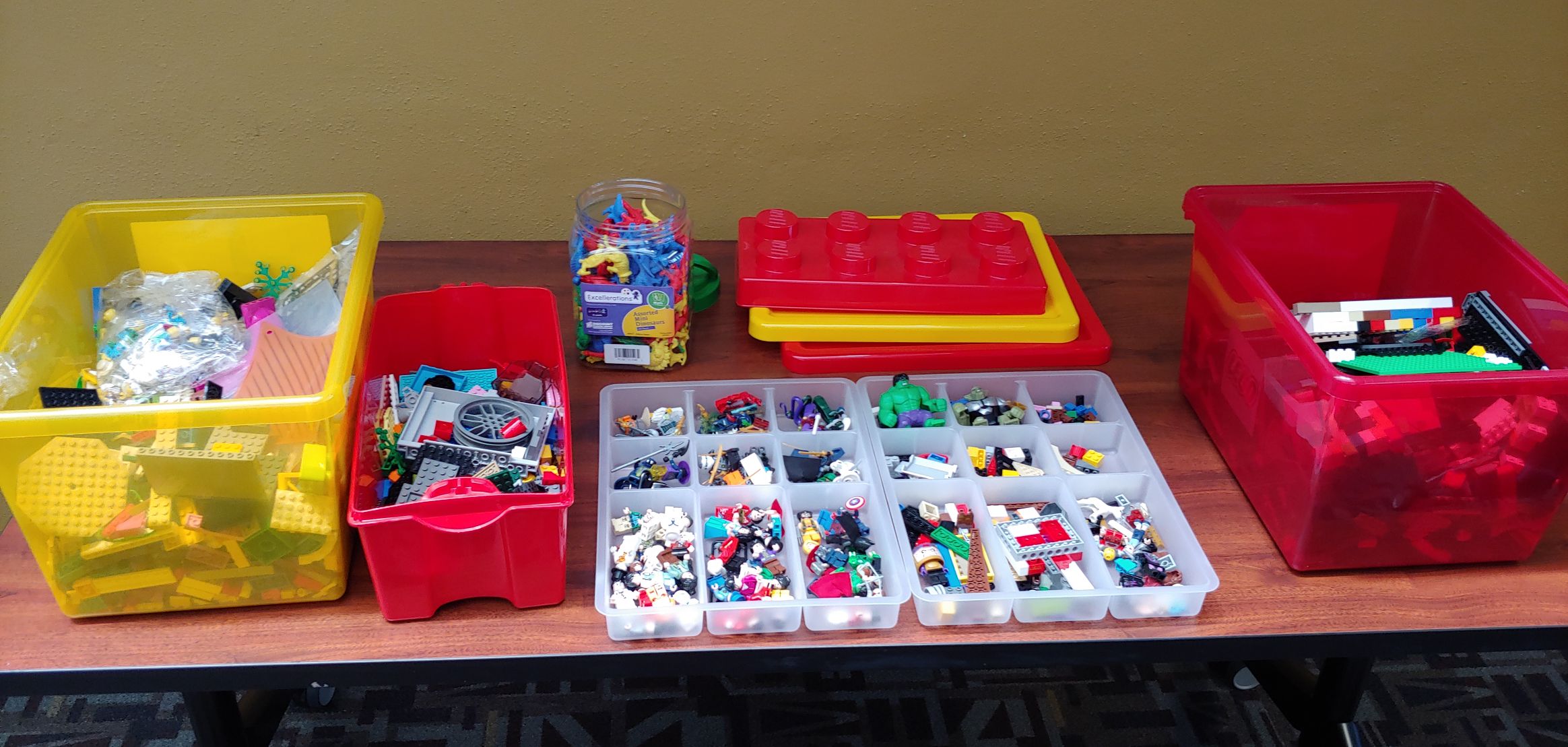
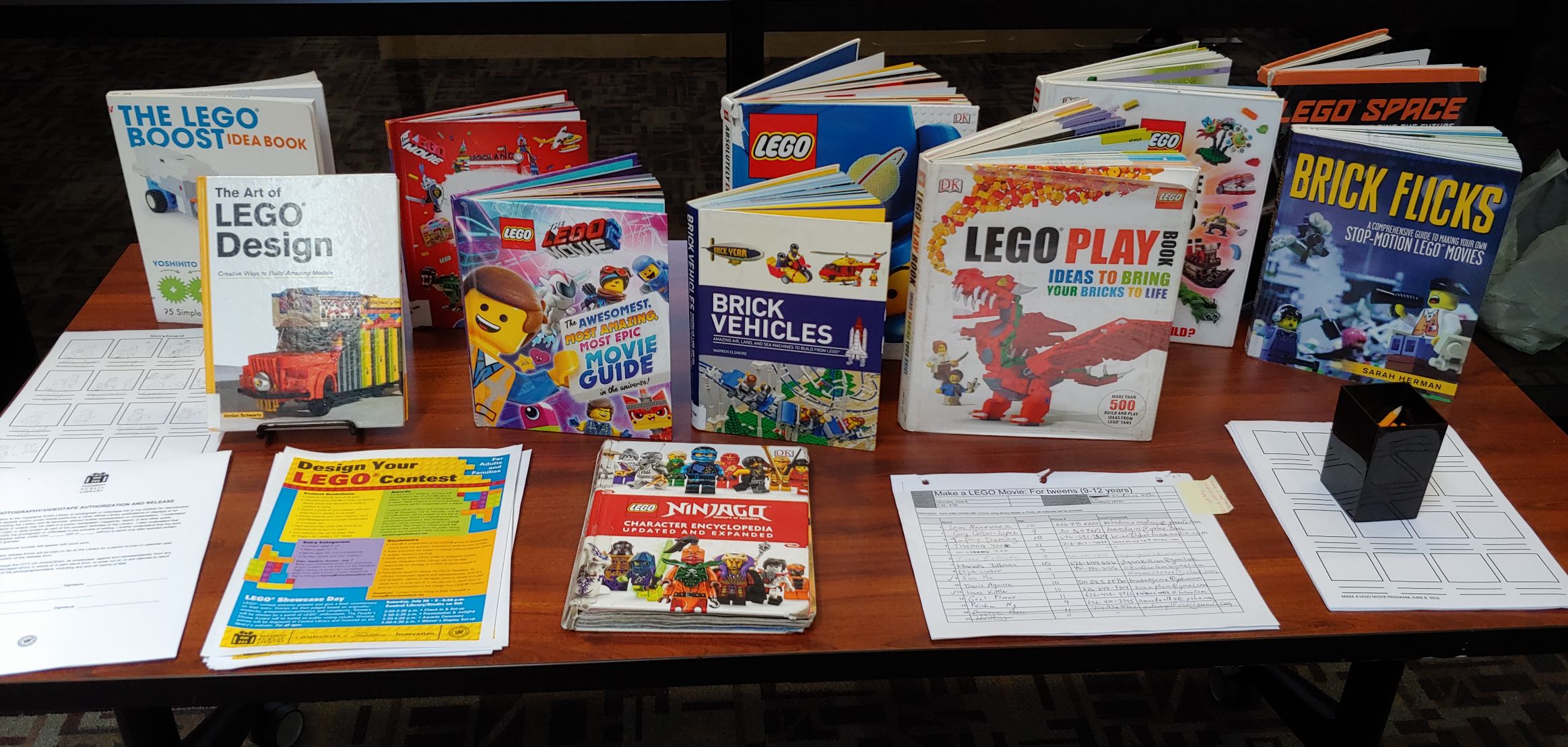
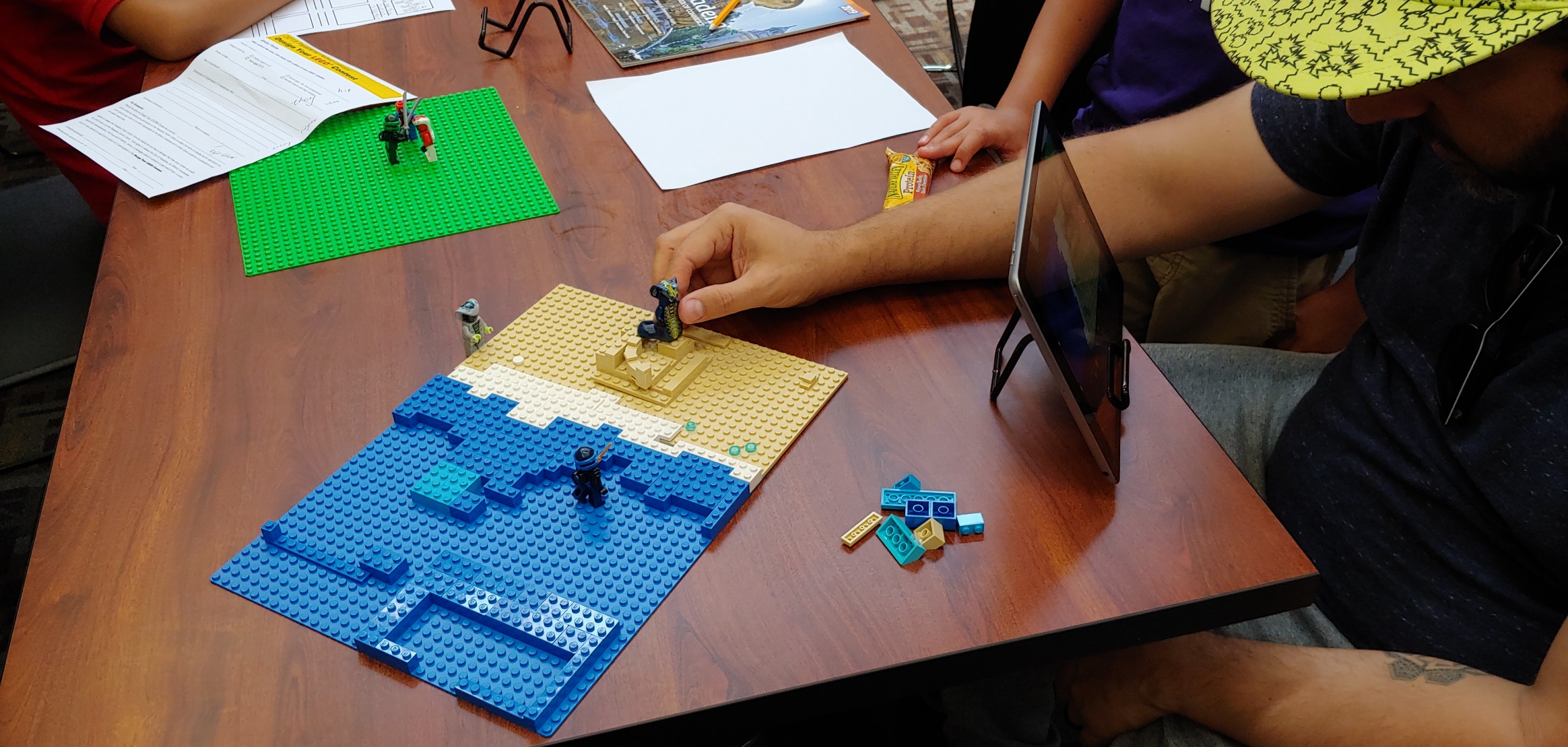
I had a book display of LEGO books, and set out our LEGOs, which the library had purchased with a grant. I had the room set up with tables and chairs. I brought over a lot of book stands, the kinds we use for displaying books, because they're perfect for holding an iPad steady!


Since some kids arrived early, they got to watch ten minutes of The Magic Portal by Lindsay Fleay. They sat in front of the TV screens first. Then they got to line up by the LEGOs and select just two minifigures, and go to the tables to work on their storyboards. This gave everyone a chance to get a superhero minifigure they liked without any one kid hogging all the superheroes, for example. But with the younger group, choosing minifigures took a little too long. I think next time I need to wrap two lines around the table, like at a salad bar, to keep things moving.

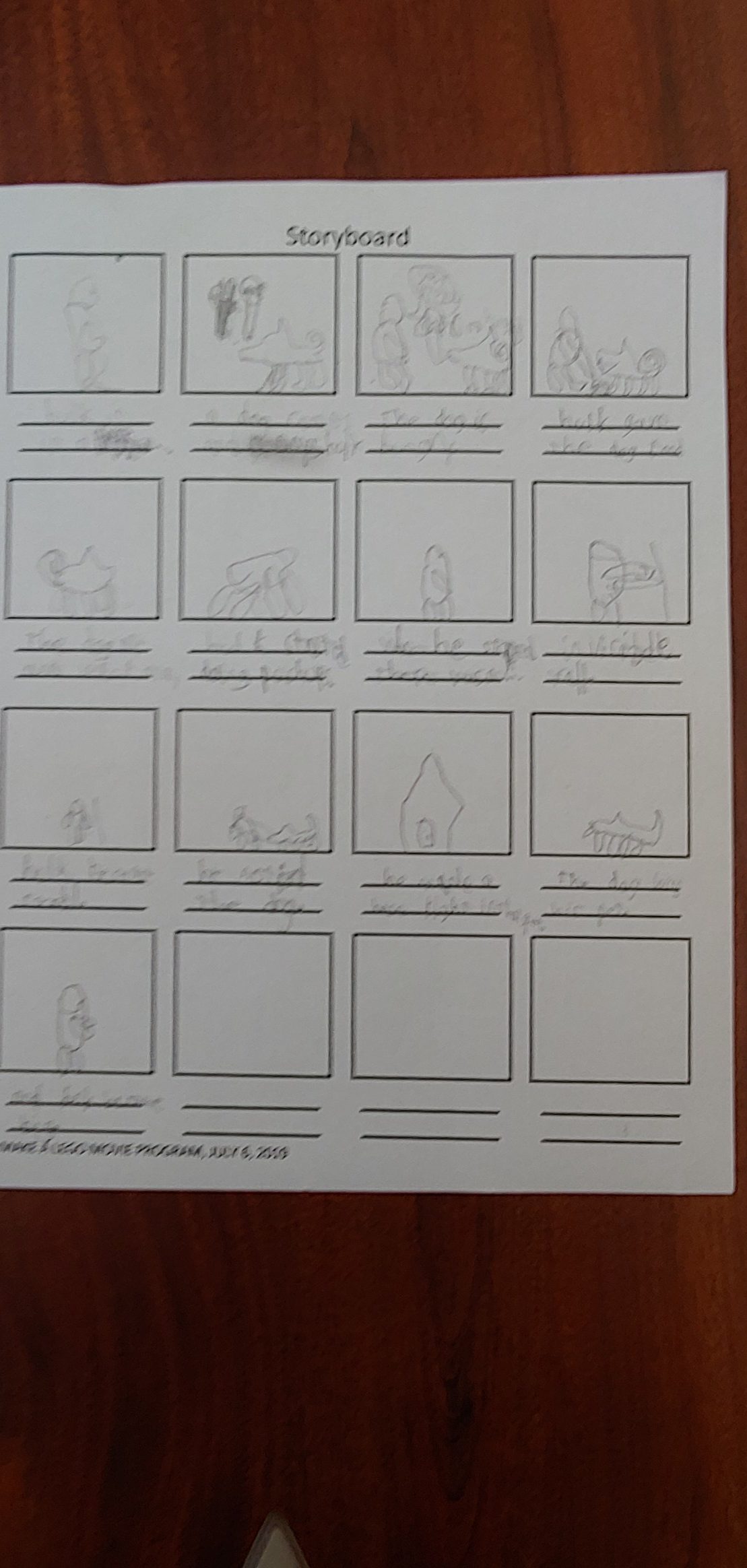
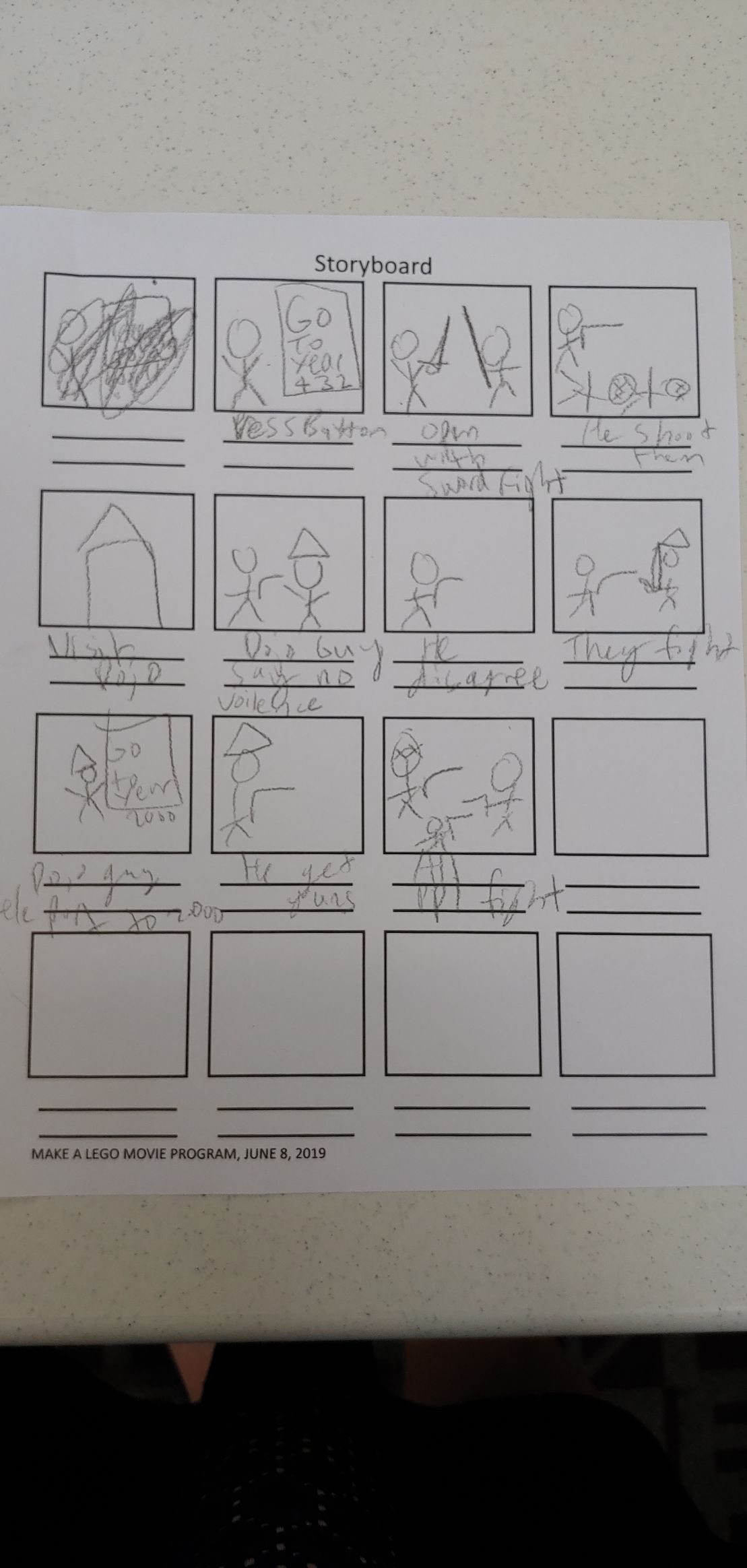
The kids did very good storyboards, and I think the act of writing down some ideas and drawing stick-men pictures helped them to get their creative juices flowing. Some were very short, others had a lot of dialogue or notes in their storyboards.


Lights, Camera, Action!


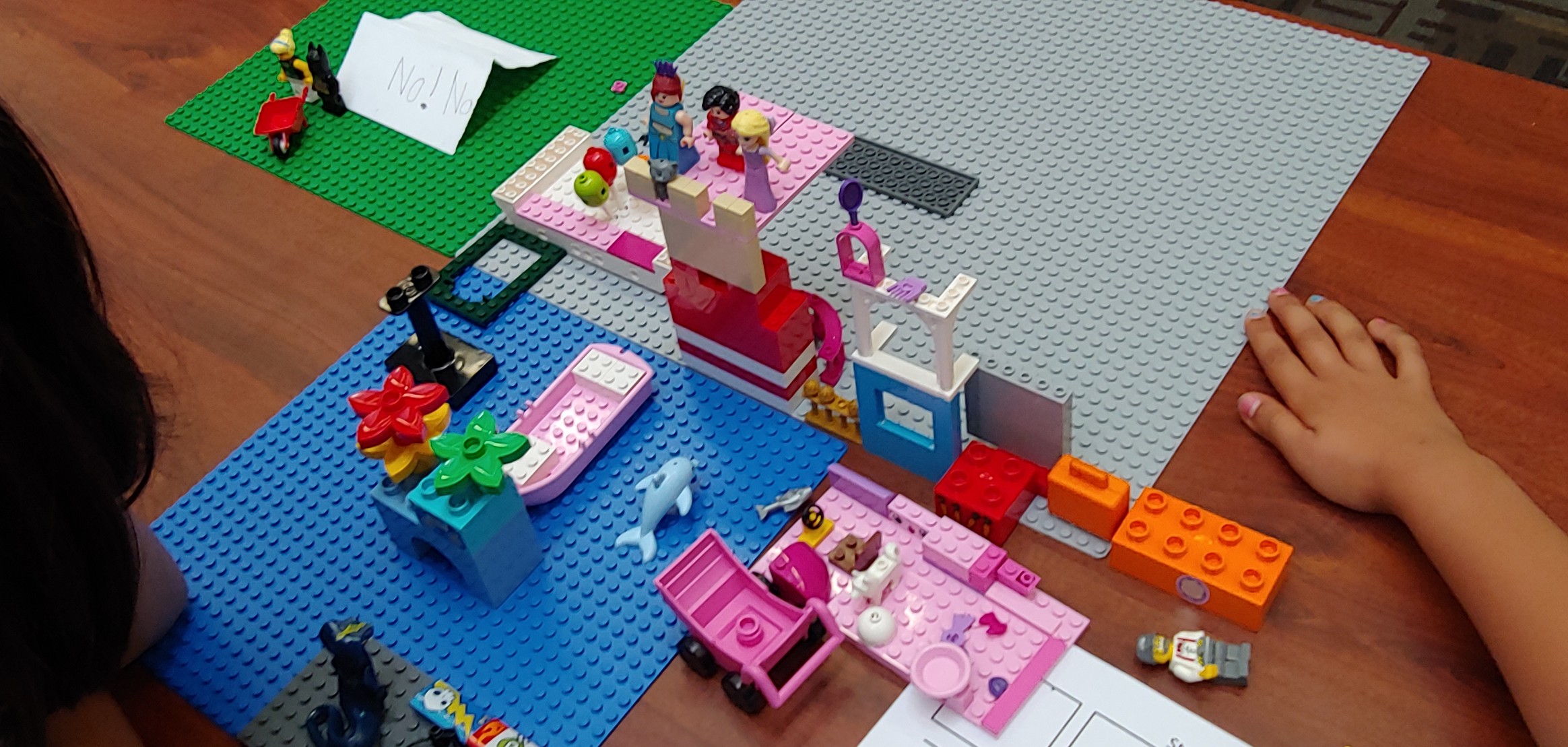
After about 15 minutes working on storyboards, kids were allowed to start filming. Note: It's important to have not only lots of minifigures, but also lots of flat LEGO platforms! I simply can't overstate how quickly these platforms go! If you're going to do a LEGO program of some kind, make sure you have a ton of them.


Their finished LEGO Movies

We showed each child's LEGO movie to applause from parents and kids! It took a while to download the videos from each iPad and upload them to YouTube. I've now uploaded all the videos from the iPads to YouTube. You can watch them on the Pasadena Public Library YouTube channel: https://www.youtube.com/user/pasadenalibrary, and on our blog at: http://pasadena-library.net/kids/2019/its-showtime-lego-movies-made-by-younger-kids/, and http://pasadena-library.net/kids/2019/its-showtime-stop-motion-lego-movies-made-by-tweens/.

For some videos, I slowed the speed a little bit so that the viewer can see what's going on or read the words a bit easier, though I was hesitant to make any big changes to anyone's film.

I was so proud of what these kids did! Many made an effort to incorporate the ideas I shared in the Powerpoint. They got really creative with the whole project. Some of them also created little speech bubbles with paper, or recorded their voices. Some of them used audio sound effects from the app to great effect. A lot of kids and parents got creative with letting us view the LEGOs at different angles. And their storytelling was so cool! I was glad to see that they grasped what you can and can't do in a ten-second short, and most of them were able to present a short story with basically a beginning, middle and end.

I got a few videos sent to me by parents after their child had a chance to work on it some more, and some children went home and created all new videos! It's always nice to see that they not only enjoyed themselves while they were at the library, but they also brought that skill home and applied it again to have fun learning and creating!

Saturday, March 9, 2019

Easy Peasy Comic Strip Activity!


The other night I went to an elementary school to do an outreach for their annual Dr. Seuss Pajama Night, and every year I try to give the kids something a little different, and appealing to all age levels. This year I used the handouts from my book, the lesson on the book The Pigeon Needs a Bath by Mo Willems.


I brought this book and other Pigeon books along for parents and kids to read:


The nature of this particular outreach is that I'm set up in a classroom and families are coming in and out all night. So it's not really possible to do a storytime--people would only catch parts of it as they're supposed to hit all the classrooms before the event closes. They usually spend only fifteen minutes with me, so I brought an activity that required very little instruction.

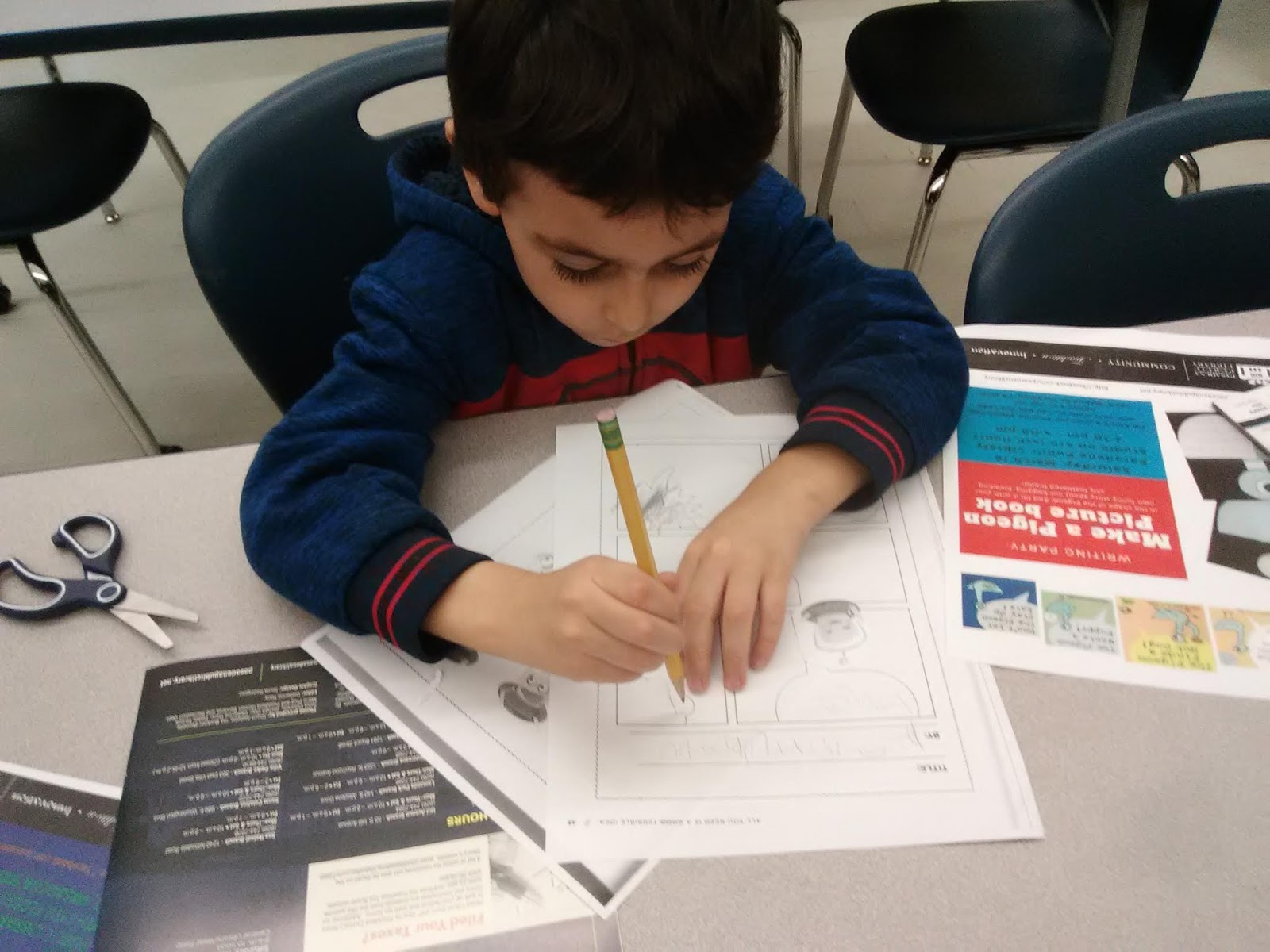
I started out by handing each kid that comes in a copy of my handouts and prompting them with the question: "Do you like comic strips? We're making our own comic strips tonight!"

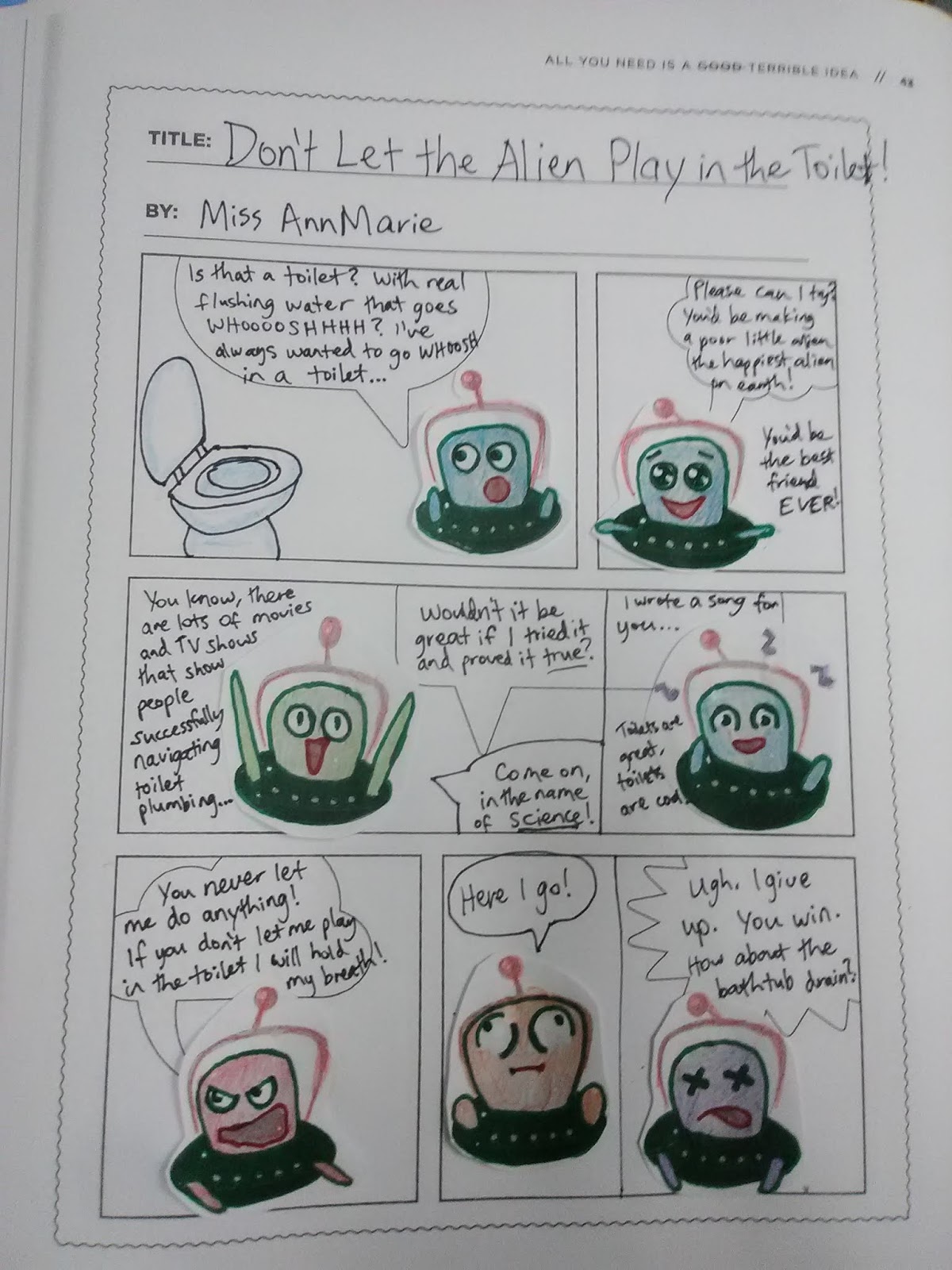
I also showed them the sample I made (feel free to steal this dialogue and use it if you like it):


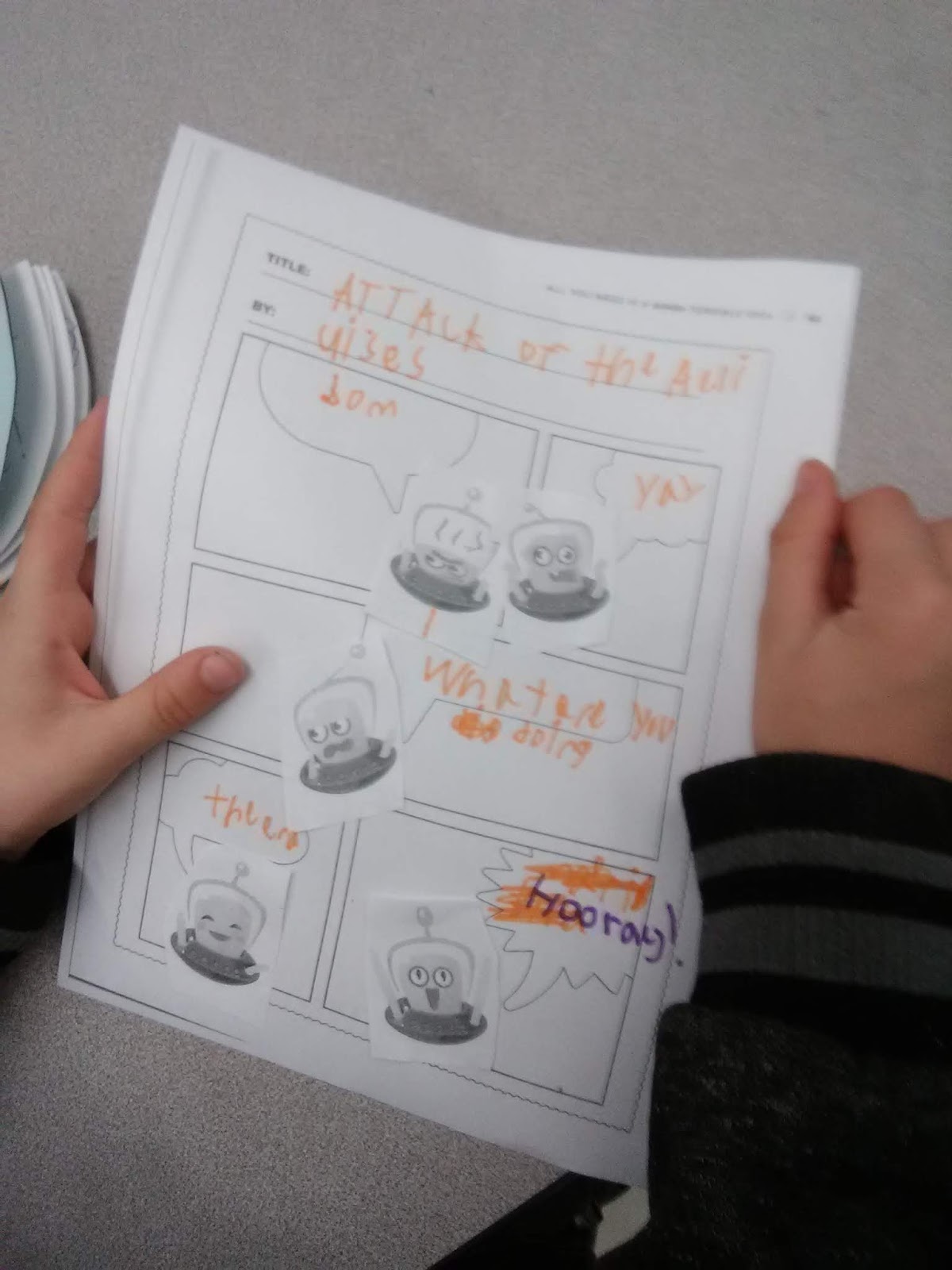
The kids loved the cute little aliens and all the varied and dramatic expressions he/she/it makes! They got right to work cutting out the aliens and gluing them to the comic strip layout. Then they got creative with giving their aliens words:


Here are some of their finished comic strips!


It turned out to be the perfect activity for the wide range of skill levels and ages that all these children had. Everybody got something out of it and made something they liked. Everybody loves comic strips!

Friday, November 16, 2018

Writing Interactive Fiction with Twine


Last month, kids came to the library to learn how to write a "Choose Your Own Adventure" type of story using a free web-based software called Twine. I walked them through the steps of it and they were very quickly writing stories with twists that the reader could choose. Here are my presentation slides, which you can feel free to use or adapt:


I was pleasantly surprised that many kids wanted to know how to code their Twine story to prompt the reader to type his/her name, and then remember that name throughout the story! I had never done that before but did the best I could to find a good code that would work. We used this Harlowe code to create a variable the user could enter:

(set: $name to (prompt: "What is your name?", ""))


It ends up looking like this:


The kids were so excited to see that users could personalize their stories! It turned into quite a hybrid STEAM/Creative Writing program after all!

Tuesday, June 12, 2018

Rewriting Fairytales

A couple weeks ago (right before I left for my vacation) we had a fun Kids' Writing Workshop all about rewriting fairytales. I always try to keep my workshops rooted firmly in books in the library's collection, so for this workshop I had fun gathering up all of the Jack and the Beanstalk retellings I could find, and putting them on display! There were several Old West retellings, including one where the Jack character is a cowgirl and one where the Jack character is a really badass Native American gunslinging bandit, two science fiction ones taking place on other planets or in outer space, a few told from the point of view of the giant, a few longer novel-length works where Jack's character and motivations are much more developed and in which Jack interacts with other fairytale characters from other stories, and more, more, more!!


The kids and I talked about what makes a good rewritten fairytale--that it helps to have some sort of "twist" on the story, either by changing a character's gender, age, cultural background, setting, or even the genre of the fairytale (like those Western and sci-fi versions of Jack). 


Then I had the kids draw slips from three envelopes. One envelope had slips of paper with fairytale characters' names. Another had papers with problems or plot elements. And the third had suggestions for how to make the fairytale different with a "twist." Kids drew two character slips, two problem slips and two twist slips, so that nobody was "forced" to write about any specific character or concept but had options to choose from and could go where the inspiration took them! I took pictures of each child's slips:

This child wrote about Rapunzel's witch trying to make amends by helping Gretel, who was blind.

This was mine--I wrote about the son of the Big Bad Wolf being a nerd who is bullied by the sons of the Three Little Pigs!

This child wrote about Red Riding Hood's Grandma and set the story in a different time in history.

This child told a story about Rapunzel's child and had another character turned into an animal.

It was really fun to see what the kids brainstormed for their rewritten fairytales, and also how they managed to tell their stories with interesting first-person points of view! I know I'll be doing this workshop again and am sure I will once again find lots of inspirations in the books here at the library.


Tuesday, April 24, 2018

Poetry Creation Stations Recap and Templates

Sometimes I'll be reading a post about an elaborate or complicated library program and wonder, "Gee, how did he/she manage to have all those things going on at the same time?" So today I'm going to do a recap of my Poetry Creation Stations program last week in our Kids' Writing Workshop, and start with how I set up the room.

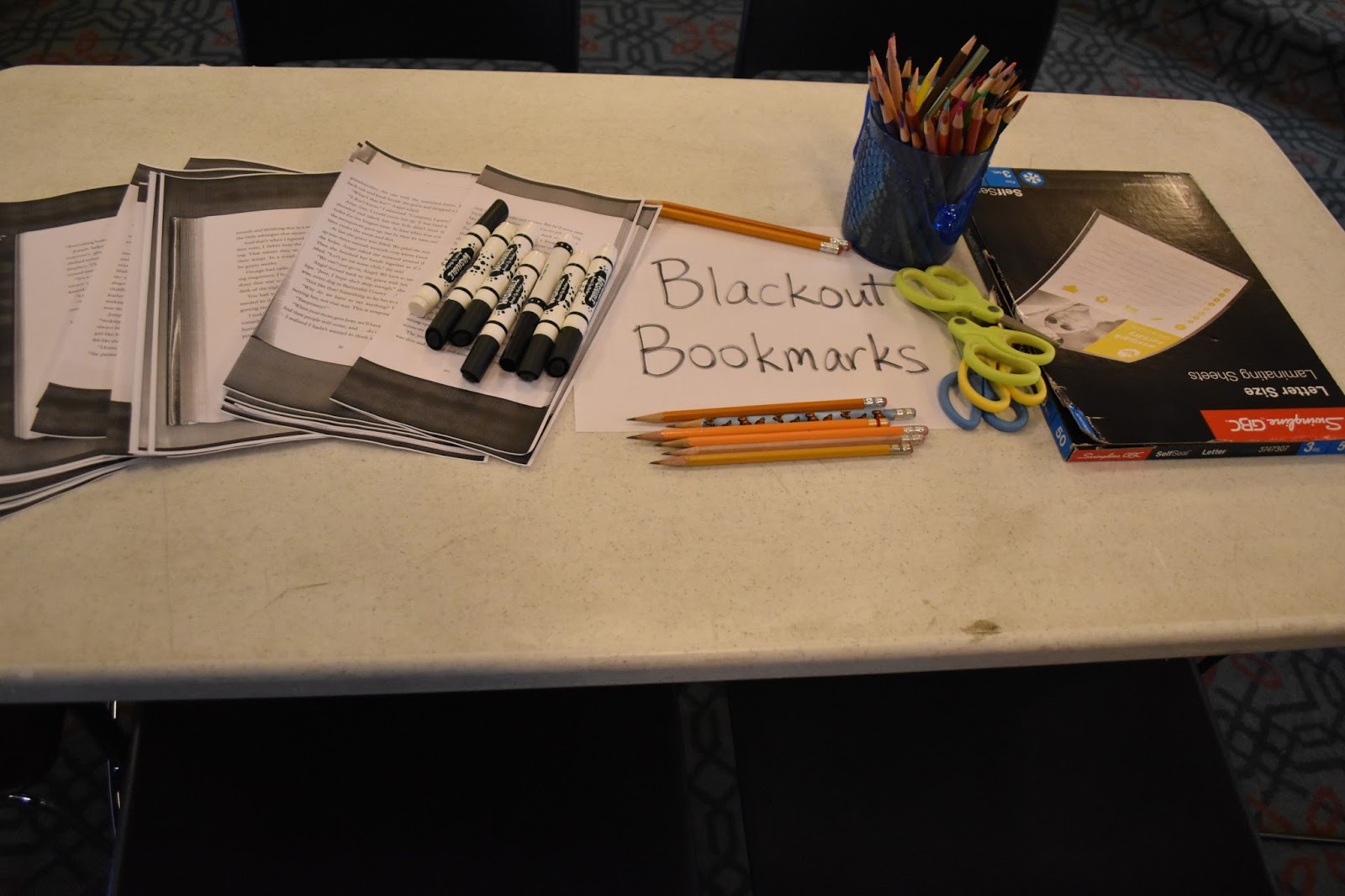
We had four tables set up with the four different activities: Paint Chip Poetry, Reverse Poetry, Haikubes and Blackout Bookmarks.


Near each table, I put up a poster with instructions for what to do:


I created template handouts for the kids sitting at the Paint Chip Poetry and Reverse Poetry tables:


The kids had so much fun! Cleanup took a while, but I would definitely do this program again. The games and activities inspired a lot of great images from the kids. One child wrote a reverse poem about killing in self-defense:

Another wrote a reverse poem about telling the truth:


There was a Paint Chip Poetry poem about boundaries being a challenge "like a seedling" that has not ceased to grow:


Kids got a lot of great imagery from the games Haikubes and Paint Chip Poetry, including "red velvet tears" and "a pool of simple riches:


They had a harder time with blackout poetry. Some thought you were just supposed to find interesting words and others had trouble making their lines coherent. That's always been a challenging style for tweens and may be more ideal for teens. But they had fun doing it. I really liked this kid's poem:


Visit http://pasadena-library.net/kids/2018/poetry-month-creation-stations-kids-writing-workshop to see more photos and videos of kids reading their poems!